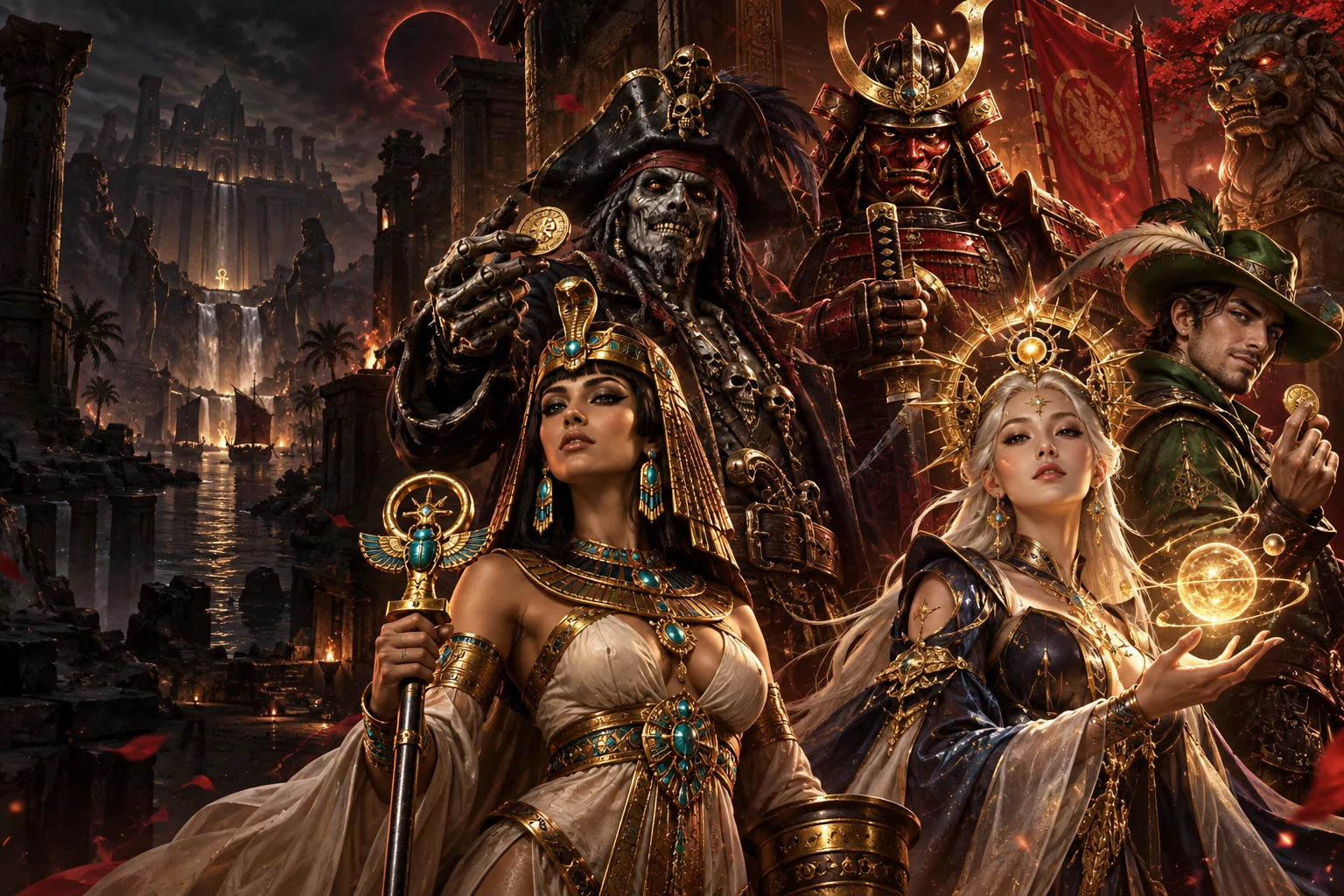
If you’ve never bought slot art from an outside studio before, the first question isn’t “who’s good?” — it’s “what am I actually paying for?” The term art pack gets used loosely across the industry, and studios fill it with wildly different things. This guide breaks down what a real, integration-ready slot art pack contains, what it costs at each tier, and the questions that separate a studio you can hand a production schedule to from one that hands you a stack of flat images and a headache.
What’s actually inside a slot art pack
A complete pack for a standard 5x3 slot generally includes:
- 10–12 symbols — low-pay, mid-pay, high-pay and wild/scatter, each delivered as a layered source file, not a flattened export
- A base game background — the reel frame environment the player sees on every idle spin
- A bonus/free spins background — visually distinct enough to signal a mode change at a glance
- Logo lockup — the game’s title treatment, usually in at least two aspect ratios (landscape key art, square/app icon)
- Core UI — spin button, bet controls, win frame, paytable icons, in the game’s visual language rather than generic placeholder buttons
That’s the floor. Anything animated — win celebrations, symbol idle loops, transitions — is a separate scope, because it requires a different pipeline (Spine rigs, sprite sheets or shader-driven effects) and a different skill set from static illustration.
What it should cost
Pricing varies by studio size and region, but for a founder-led or boutique operation delivering production-quality work, expect:
| Deliverable | Typical range |
|---|---|
| Style test / single symbol in your exact visual language | $500–$800 |
| Full static art production (10–12 symbols, backgrounds, logo, UI) | $4,000–$6,000 |
| Visual reskin of an existing game | $4,000–$6,000 |
| Animated production (rigged symbols, win animation, VFX) | $7,000–$10,000 |
| Playable demo upgrade (your art running on a real math engine) | +$3,000–$4,000 |
Turnaround for a static pack usually runs two to three weeks once the brief is locked. Animated work adds another one to two weeks because rigging and testing take real time regardless of how good the concept art is.
Pro tip: if a quote for a full static pack comes in dramatically below $3,000, ask directly what’s included. It’s usually a smaller symbol count, no layered source files, or no revision rounds — not a discount on the same scope.
Layered files vs. flattened exports
This is the single biggest quality signal, and it’s invisible until you actually try to integrate the assets. A studio delivering production-ready work hands you:
- Layered PSD or equivalent source files, organized and named consistently
- Separated elements (character, background, effects, glow) so your engine team can composite and animate later without re-drawing anything
- A naming convention that matches what you’d expect in your asset pipeline, not “final_v3_USE_THIS.png”
A studio delivering flattened PNGs only is handing you finished pictures, not production assets. That’s fine for a pitch deck. It’s not fine for a live game your engine team has to integrate, patch, and eventually reskin again.
Questions to ask before you commission a full pack
- Can I see a style test first? A studio confident in matching your visual language should offer a small, paid proof point before you commit to a full production budget.
- How many revision rounds are included, and how are they batched? “Unlimited revisions” usually means unlimited scope creep. Two consolidated rounds per milestone is the healthier structure — it forces feedback to be specific instead of drip-fed.
- What’s the delivery format, and is there a manifest? A written list of every file, its naming convention, and its intended use tells you the studio thinks about handoff, not just output.
- When do IP rights transfer? Rights should transfer on full and cleared payment — not on delivery of drafts, and not before the invoice is actually settled.
- Is there a fixed price and fixed scope, or is it “from”? “From $4,500” is normal — it means the price depends on symbol count and complexity. What matters is that you get an actual number in writing before production starts, not after.
The real risk isn’t price — it’s fit
The studios that disappoint buyers rarely fail on craft. They fail on style match: the delivered art is technically well-made but doesn’t read like your game. That’s why a paid style test exists as a category — it lets you verify fit on one asset before you commit a production budget to a studio you’ve never worked with.
If you’re evaluating a new art partner, start small, verify the layered files, verify the naming convention, and only then scale up to a full production or a reskin. The studios worth working with long-term will encourage exactly that sequence — because they’re confident the small test converts.
Huge Mega Play produces slot art, reskins and animated productions for casino studios and suppliers, with a $650 style test creditable toward full production. See current offers →